Showing posts with label Warbler. Show all posts

21 January 2026

Black-browed Reed Warbler

Passeriformes - Acrocephalidae - Acrocephalus bistrigiceps (Cekup-Paya Kecil Biasa) 

Dull brown reed warbler with a sharply marked head, found in a variety of wetland habitats with substantial vegetation cover. Namesake black brow line is not always apparent, but the thick and strikingly pale supercilium is distinctive in its clean-cut and squared-off appearance. Somewhat similar to the rarer Streaked Reed Warbler, but averages much darker and lacks the latter's black striping on the back and wings. Song is a scrambled set of chatters, chirps, and rattles, more musical and tuneful than Oriental Reed Warbler. Gives dry “chit,” often in series.
(eBird)


"Ask questions from your heart and you will be answered from the heart."


09 January 2026

Eastern-crowned Warbler

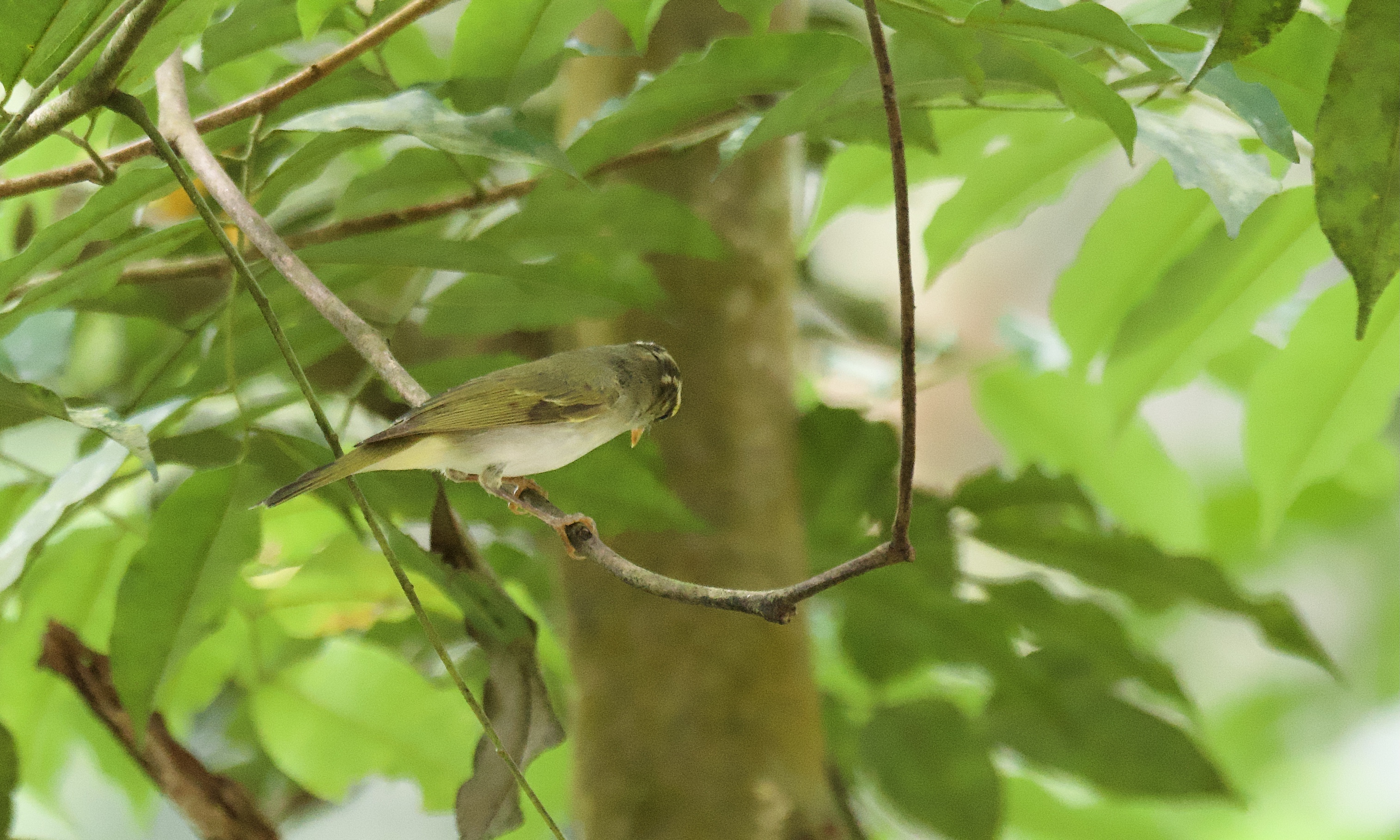
Passeriformes - Phylloscopidae - Phylloscopus corornatus (Cekup Daun Tongkeng)

 A boldly marked songbird, rather large for a leaf warbler, usually seen foraging in the canopy. From below, a bright yellow vent and broad orange-based bill distinguish it from most other local leaf- warblers. Crisp yellow-tinged olive above, with very weak thin wingbars and black-bordered white eyebrow. Pale crown stripe is often not visible. Similar to Claudia's, Blyth's, and Hartert's Leaf- Warblers but head pattern is more powerfully contrasting in Eastern Crowned. Song is a burst of two or three “wi-tcher” calls, followed by a wheezy and tuneless “reee.” Unlike other leaf-warblers, seldom calls on wintering grounds but sometimes gives a brief “fit” or sweeter “chi” (the latter sounding like Ijima’s common call). Breeds in openings, edges, and cuts in well-forested areas; can be found in a wide range of wooded habitats when not breeding.
(eBird)


"There are two ways to live your life.  One is as though nothing is a miracle.  The other is as though everything is a miracle."


18 March 2025

Eastern-crowned Warbler

Passeriformes - Phylloscopidae - Phylloscopus corornatus (Cekup Daun Tongkeng)

 A boldly marked songbird, rather large for a leaf warbler, usually seen foraging in the canopy. From below, a bright yellow vent and broad orange-based bill distinguish it from most other local leaf- warblers. Crisp yellow-tinged olive above, with very weak thin wingbars and black-bordered white eyebrow. Pale crown stripe is often not visible. Similar to Claudia's, Blyth's, and Hartert's Leaf- Warblers but head pattern is more powerfully contrasting in Eastern Crowned. Song is a burst of two or three “wi-tcher” calls, followed by a wheezy and tuneless “reee.” Unlike other leaf-warblers, seldom calls on wintering grounds but sometimes gives a brief “fit” or sweeter “chi” (the latter sounding like Ijima’s common call). Breeds in openings, edges, and cuts in well-forested areas; can be found in a wide range of wooded habitats when not breeding.
(eBird)


When something never changes - who changes.


* Adaptation to change - change without going over the edge *
- adapt without compromising - 


16 January 2025

Eastern-crowned Warbler

Passeriformes - Phylloscopidae - Phylloscopus corornatus (Cekup Daun Tongkeng)


A boldly marked songbird, rather large for a leaf warbler, usually seen foraging in the canopy. From below, a bright yellow vent and broad orange-based bill distinguish it from most other local leaf- warblers. Crisp yellow-tinged olive above, with very weak thin wingbars and black-bordered white eyebrow. Pale crown stripe is often not visible. Similar to Claudia's, Blyth's, and Hartert's Leaf- Warblers but head pattern is more powerfully contrasting in Eastern Crowned. Song is a burst of two or three “wi-tcher” calls, followed by a wheezy and tuneless “reee.” Unlike other leaf-warblers, seldom calls on wintering grounds but sometimes gives a brief “fit” or sweeter “chi” (the latter sounding like Ijima’s common call). Breeds in openings, edges, and cuts in well-forested areas; can be found in a wide range of wooded habitats when not breeding.
(eBird)


Tireless seeker


* To discriminate virtue - know yourself vs know others
- we walk different paths -


17 October 2022

"No place for fear"


"No place for fear"


When your thoughts are at peace and have become transparent,
You see the true form of the mind.
When your feelings are at rest and have become tranquil,
You understand the true movement of the mind.
When your disposition is impartial and totally calm,
You obtain the true flavor of the mind.
There is nothing that can rival these three.

Hung Ying-ming


05 February 2022

what the mind takes on


illusion, delusion
and it goes on,
yet the mind, the heart
all from the same source